
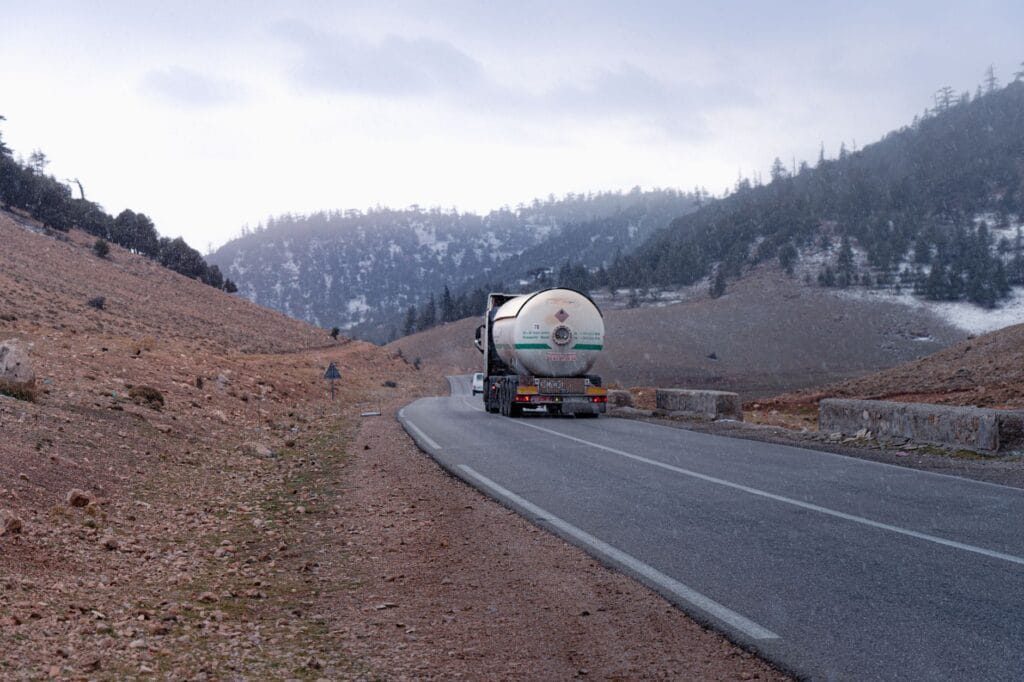
The incidents in the Dinar district of Afyonkarahisar in August 2026 brought to the forefront a type of liability that most drivers never consider. On the Dinar-Çay highway, a chemical substance spilled from a lorry reacted after rainfall, spread onto the asphalt, and stained the tyres, rims, bumpers and undercarriages of numerous passing vehicles purple. Legally, the resulting situation falls under a single heading: vehicle damage caused by paint spilled on the road, i.e., material damage to your vehicle caused by the act of a third party. So who is liable for this damage?
What Happened in the Incident, and What Penalties Were Imposed?
The substance on the highway could only be removed after three days of work by teams, by scraping off the asphalt. The lorry driver was given an administrative fine and penalty points on their driving licence under traffic regulations. The Office of the Chief Public Prosecutor also launched a criminal investigation into the offences of “negligent pollution of the environment” and “endangering traffic safety”. The Ministry of Environment, Urbanisation and Climate Change, in turn, imposed administrative fines amounting to millions of lira on the companies responsible for the pollution.
Here, it is necessary to address a common misconception. Both the administrative fine and the criminal investigation concern the relationship between the state and the offender. The fact that these penalties have been imposed does not mean that the person whose vehicle was damaged will automatically receive payment. Compensation for material damage is a completely separate legal avenue and must be specifically claimed by the injured party.
Who Is Liable for Vehicle Damage Caused by Paint Spilled on the Road?
Under the tort provisions of the Turkish Code of Obligations, a person who, through their fault, causes harm to another is obliged to compensate that harm. If the load is not properly secured or is spilled onto the road during transport, liability is often not concentrated on a single party. The driver, the operator of the vehicle, the company that loaded the cargo, and the company that undertook the transport may all be held jointly liable. The extent of each party’s liability is determined by examining the loading conditions and the manner in which the incident occurred.
The Highway Traffic Law, on the other hand, separately regulates the operator’s liability for material damage arising from the operation of a motor vehicle. This is an aggravated form of no-fault liability; the injured party does not need to prove the operator’s fault. Therefore, in the event of damage caused by a substance spilled on the highway, claims can often be directed against multiple parties at the same time.
Does Traffic Insurance Cover This Damage?
The injured party has the right to apply directly to the insurer providing the vehicle’s compulsory motor third-party liability insurance. However, whether damage arising from cargo or environmental pollution falls within the policy coverage must be assessed on a case-by-case basis. The policy wording, coverage exclusions, and whether the incident qualifies as “operation” directly affect the outcome. If you are able to receive payment under your own comprehensive motor insurance (casco) policy, the insurance company may seek recourse against the liable parties for the amount paid. Therefore, a casco claim and a compensation claim are not alternatives to each other but are often complementary avenues.
Documenting the Damage Is Crucial
In such incidents, the most critical stage is proving the damage. Cleaning or repainting the vehicle often eliminates the only evidence of the damage. Therefore, before cleaning, it is necessary to photograph the vehicle with the date visible, obtain an official report from law enforcement at the scene, secure a report from an authorised service centre or expert, and obtain invoices for all payments.
If the nature or extent of the damage is disputed, it is possible to request preservation of evidence from the court before filing a lawsuit. Preservation of evidence allows the current situation to be recorded by an expert appointed for that purpose and significantly eases the burden of proof in later stages. The items that can be claimed are not limited to cleaning and repainting costs; the decrease in the vehicle’s market value, i.e., loss of value, can also be claimed.
Do Not Miss the Time Limits for Claims
Compensation claims arising from a tort are subject to a short limitation period that begins when the injured party learns of the damage and the tortfeasor. If the act also constitutes a crime, the longer limitation period provided for in criminal law may apply. Applications to the insurer are subject to separate time limits under the policy and the law. Therefore, calculating the applicable time limits at the very beginning of the process is crucial to avoid loss of rights.
Conclusion
Vehicle damage caused by paint spilled on the road is not a “misfortune” to be shrugged off, but material damage that can be pursued legally. The fact that the offender has been punished does not mean the damage has been compensated. If the liable parties are correctly identified, the scope of insurance coverage is examined, and the damage is properly documented, claims for cleaning, repainting, and loss of value can be made. If you encounter a similar incident, recording the situation before having your vehicle cleaned is the most important step.
This article is for general informational purposes only. Since the circumstances of each case, the allocation of liability, and the applicable time limits may differ, it is recommended that you seek legal advice from your attorney for your specific situation.